Wholesale and industrial procurement is fundamentally different from consumer retail. B2B buyers—plant engineers, facility operators, and purchasing managers—do not purchase based on lifestyle branding. They purchase based on dimensional tolerances, alloy grade certifications, volume tier pricing, and instant quote generation. This project demonstrates how to structure a 50,000+ SKU technical catalog natively on Shopify without sluggish third-party app dependencies.
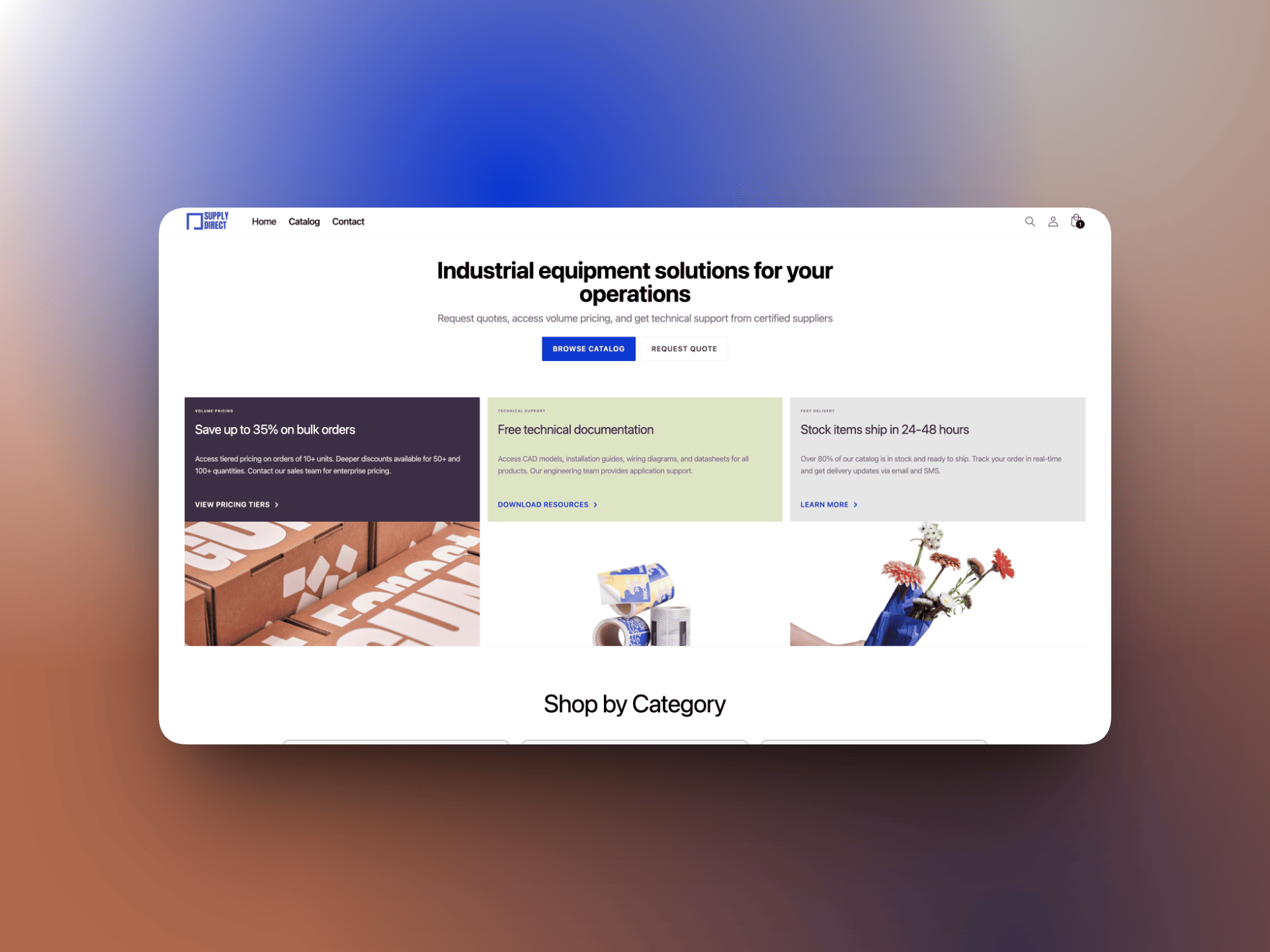
Why standard Shopify themes fall apart under the weight of industrial specifications and complex wholesale rules.
Most industrial suppliers and distributors operate in digital paralysis. They are trapped between sluggish legacy ERP customer portals that require days of training to navigate, and generic consumer Shopify themes that treat a precision CNC fastener the exact same way they treat a cotton t-shirt.
When an enterprise buyer visits a Shopify B2B store, their procurement workflow requires instant answers to four critical questions:
Does this exact alloy meet ASTM / ISO tolerances for our machinery?
What is our discounted unit price at 50, 500, or 2,500 units?
Can we buy now via corporate card, or do we need a formal RFQ with Net 30 terms?
Can we download CAD models for assembly simulation and verify dispatch hubs?
Standard Shopify templates hide these answers behind buried tabs or force merchants to install half a dozen third-party apps. Each app injects external JavaScript, slows down load times, and creates a fragmented checkout flow. This project was designed to test whether all of these high-utility Shopify B2B features could be engineered directly into the native theme architecture.
In industrial shopify b2b commerce, product attributes are dense and multi-dimensional. We bypassed third-party spec table plugins entirely, creating a native schema using Shopify Metaobjects and variant-level metafields rendered directly into server-side Liquid templates.
| Specification Parameter | Engineered Value | Standard / Verification |
|---|---|---|
| Tensile Strength (Yield) | 620 MPa (89.9 ksi) | Verified ASTM A193 |
| Torque Rating (Max) | 320 N·m (236 lbf·ft) | ISO 898-1 Class 10.9 |
| Operating Temperature | -196°C to +400°C (-320°F to +752°F) | Cryogenic Rated |
| Thread Standard | UNC / UNF Class 2A / 2B Fit | ASME B1.1 Compliant |
| Hardness Rating | Rockwell C 32–39 (HRC) | NACE MR0175 Compliant |
Every SKU links to structured metaobjects for material composition, yield strength, and compliance standards. Updates to an alloy certification propagate across thousands of products instantly.
Specification tables are rendered server-side via Liquid without client-side DOM rewrites. This guarantees instantaneous rendering with zero cumulative layout shift (CLS).
Native file metafields provide 1-click downloads for .STEP, .IGES, and vector PDF spec sheets, giving engineers the files they need for CAD assemblies before purchasing.
Empowering bulk procurement with transparent quantity discounts and automatic tiered discounts without requiring third-party discount apps.
B2B transactions live and die by price break transparency. Forcing a purchasing manager to add 500 items to their cart just to calculate whether they qualify for a wholesale tier creates massive drop-off.
We engineered a dynamic volume discount engine that displays clear quantity thresholds directly above the buy-box. When adjusting quantities via the stepper or input field, unit costs and total savings recalculate instantly.
On standard Shopify stores, volume discount apps often create dummy variant duplicates or require external script tags. In this architecture, discounts are powered by native Shopify Functions (or Shopify Plus B2B Price Lists), ensuring that wholesale pricing synchronizes flawlessly with inventory counts, ERP inventory systems, and commercial invoices.
In enterprise shopify b2b ecommerce, buyers need two distinct paths: standard catalog items can be purchased immediately via corporate purchasing cards, while high-volume custom production runs require formal quotation approval.
Rather than asking procurement managers to type freeform text into an email, the RFQ funnel pre-populates verified alloy grades, tolerance limits, and target quantities directly from the active Metaobject context.
The RFQ flow captures verified business identifiers (GSTIN, VAT, DUNS) and state tax exemption certificates. This eliminates sales tax on wholesale purchases and tags customer profiles for automatic Net Terms invoicing.
When sales engineering finalizes customized quotes, Shopify automatically generates a pre-populated Draft Order. The client receives a secure checkout link locked with their agreed volume terms and custom freight routing.
Why generic "You Might Also Like" recommendation widgets fail in B2B, and how technical part pairing drives higher order values.
In consumer fashion or beauty, cross-selling relies on visual aesthetics. In industrial manufacturing, cross-selling is an operational necessity: if an engineer buys high-pressure flange bolts, they also require the matching high-temperature gaskets, Belleville washers, and thread sealant.
Rather than generic recommendation algorithms, we engineered a dedicated Frequently Sourced With module built on native Shopify product metafields:
This architectural pattern enables multi-SKU selection with a single cart API payload, cutting friction for procurement teams while naturally elevating Average Order Value (AOV) per transaction.
Every added third-party shopify b2b app adds 200–500ms of latency, multiple network roundtrips, and CSS conflicts. Building native theme features preserves peak speed.
Static Liquid rendering and zero external CSS frameworks ensure immediate browser paint.
Pre-allocated table bounding boxes prevent visual jumps while specification matrices load.
All tabular data, volume calculations, and RFQ forms execute natively inside the theme code.
No account managers or middleman handoffs. You work directly with the developer building the store.
Direct, technical answers to common questions about structuring high-volume B2B operations on Shopify.
Yes. Depending on your licensing (Shopify Plus vs. standard Shopify), you can either utilize native Shopify Plus B2B Company Profiles and Price Lists, or build a hybrid theme with customer tag gating and custom Liquid templates. This allows retail visitors to view MSRP prices and checkout instantly, while authenticated wholesale buyers unlock dedicated tiered price lists and Net Terms.
We implement a hybrid purchasing workflow directly on the Product Detail Page (PDP) and slide-out cart. Buyers can either complete an immediate purchase using a credit card or click 'Request Wholesale Quote'. The quote funnel captures project specifications, CAD attachments, and company tax exemption details, automatically generating a Draft Order inside Shopify Admin for sales team review.
We structure technical parameters using Shopify Metaobjects and variant-level metafields rather than third-party plugins. This allows you to define parametric fields (tensile strength, tolerance classes, operating temperatures) in a structured admin schema, automatically rendering them in responsive, zero-layout-shift Liquid tables.
Installing 5+ third-party apps creates heavy script bloat, monthly subscription overhead ($200–$800/month), and fragmented UI styling that breaks across devices. For high-traffic catalogs, building native Liquid spec tables, volume pricing tiers, and RFQ forms directly into your theme ensures sub-second load times, total styling control, and zero monthly plugin fees.
We build custom data transformation pipelines using the Shopify Admin GraphQL API. We map legacy ERP fields (from systems like SAP, NetSuite, Epicor, or Microsoft Dynamics) into Shopify Products, Metaobjects, and Price Lists with automated batch scripts to maintain data integrity.
You communicate directly with the engineer writing your Liquid code, designing your Metaobject architecture, and testing your API integrations. There are no account managers, no miscommunicated specifications, and no bloated agency overhead—just focused, high-precision execution.
Whether you are migrating a 50,000+ SKU industrial catalog or need native volume pricing and RFQ workflows engineered into your Shopify storefront, let's discuss your technical requirements.
 Scale
Scale